
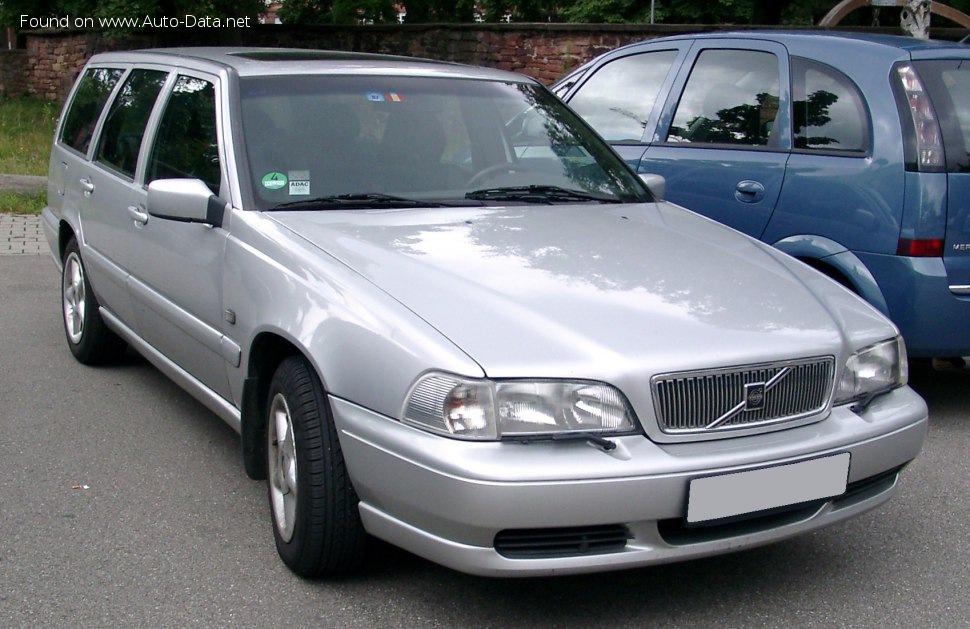
The Volvo V70 I 2.3 T (250 Hp) Automatic represents a significant chapter in Volvo’s history, embodying the brand’s commitment to safety, practicality, and performance within the premium station wagon segment. Introduced in 1996 as the successor to the highly popular 850, the first-generation V70 built upon a proven platform, refining its styling, interior, and mechanical components. This particular variant, with its potent 2.3-liter turbocharged engine and automatic transmission, was positioned as a high-performance, yet versatile, family vehicle, appealing to buyers who desired both spirited driving dynamics and the utility of a spacious wagon. While primarily a European market car, the V70 I was also a strong seller in North America, continuing Volvo’s long-standing tradition of offering practical and safe wagons to the US market, establishing itself as a benchmark for combining robust engineering with everyday usability.
The Volvo V70 I: A Legacy of Practical Performance
The first-generation Volvo V70 (1996-2000) marked an evolutionary step rather than a revolutionary one, meticulously improving upon the foundations laid by its predecessor, the 850. Volvo’s design ethos during this period was characterized by a blend of functional Scandinavian aesthetics and increasing aerodynamic sophistication. The V70 I retained the familiar, robust wagon silhouette that had become synonymous with the brand, but with softer, more rounded edges and updated front and rear fascias that lent it a more contemporary look. This generation was crucial for Volvo as it transitioned from its more angular designs of the past to a sleeker, yet still distinctly Volvo, aesthetic.
The V70 I was designed to appeal to a global audience, maintaining its strong presence in Europe and North America. Its reputation for exceptional safety, a hallmark of the Volvo brand, was further enhanced with advancements in crumple zones, side-impact protection systems (SIPS), and standard anti-lock brakes (ABS). The vehicle offered a compelling package for families and individuals seeking a reliable, safe, and spacious vehicle without compromising on driving enjoyment, particularly in its higher-performance turbocharged variants like the 2.3 T (250 Hp) Automatic.
Engine and Powertrain Dynamics
At the heart of the Volvo V70 I 2.3 T (250 Hp) Automatic lies a formidable B5234T4 engine, a 2.3-liter (141.51 cubic inches) inline five-cylinder unit. This engine configuration was a signature of Volvo during this era, renowned for its unique exhaust note, inherent balance, and robust construction. Equipped with a turbocharger and a multi-port manifold injection system, this DOHC (Double Overhead Camshaft) engine produced a significant 250 horsepower at 6000 rpm. More impressively, it delivered a robust 258.15 lb.-ft. of torque at a relatively low 2400 rpm, ensuring strong acceleration and flexible power delivery across the rev range.
The power was efficiently managed by a 5-speed automatic transmission, sending drive to the front wheels. This combination allowed the V70 I 2.3 T to accelerate from 0 to 60 mph in a brisk 7.1 seconds, with a top speed electronically limited to 149.13 mph (240 km/h). For a full-size station wagon of its time, these were highly respectable performance figures, positioning it squarely against premium European sport sedans and wagons. The automatic transmission provided smooth, refined shifts, making it an excellent choice for both daily commuting and long-distance touring, while still offering enough responsiveness for spirited driving. Despite its performance capabilities, the vehicle maintained a combined fuel economy of 22.4 US mpg, a reasonable figure for a turbocharged engine of its size and power output in the late 1990s.
Design Philosophy and Interior Comfort
The Volvo V70 I embodied a practical yet elegant design philosophy. Its five-door station wagon (estate) body type offered unparalleled versatility, a key selling point for the brand. Measuring 186.22 inches in length, 69.29 inches in width, and 56.3 inches in height, with a wheelbase of 104.72 inches, the V70 provided a substantial road presence. The relatively low drag coefficient of 0.32 contributed to both fuel efficiency and reduced wind noise at higher speeds.
Inside, the V70 I was designed with a focus on ergonomic comfort and functionality for five occupants. The cabin materials were durable and well-appointed, reflecting its premium segment positioning. Volvo’s commitment to utility was evident in the generous cargo space: a minimum of 14.83 cubic feet with all seats up, expanding to an impressive 55.8 cubic feet with the rear seats folded down. This made the V70 an ideal vehicle for everything from family road trips to hauling bulky items. Safety features for the era were comprehensive, including the standard Anti-lock Braking System (ABS), robust body construction, and advanced seating designs. The suspension system, featuring a wishbone setup in the front and coil springs in the rear, provided a comfortable ride quality while maintaining composed handling, complemented by hydraulic rack and pinion steering. The 17-inch wheels, fitted with 205/45 R17 tires, further enhanced both the aesthetic appeal and roadholding capabilities of this performance-oriented wagon.
Technical Specifications of the Volvo V70 I 2.3 T (250 Hp) Automatic
| General Information | |
|---|---|
| Brand | Volvo |
| Model | V70 |
| Generation | V70 I |
| Type (Engine) | 2.3 T (250 Hp) Automatic |
| Start of Production | 1996 year |
| End of Production | 2000 year |
| Powertrain Architecture | Internal Combustion Engine |
| Body Type | Station wagon (estate) |
| Seats | 5 |
| Doors | 5 |
| Performance Specifications | |
| Fuel Consumption (combined) | 10.5 l/100 km (22.4 US mpg) |
| Fuel Type | Petrol (Gasoline) |
| Acceleration 0 – 60 mph | 7.1 sec |
| Maximum Speed | 149.13 mph (240 km/h) |
| Weight-to-Power Ratio | 6.6 kg/Hp, 150.6 Hp/tonne |
| Weight-to-Torque Ratio | 4.7 kg/Nm, 210.8 Nm/tonne |
| Engine Specifications | |
| Power | 250 Hp @ 6000 rpm |
| Power per liter | 107.8 Hp/l |
| Torque | 258.15 lb.-ft. (350 Nm) @ 2400 rpm |
| Engine Layout | Front, Transverse |
| Engine Model/Code | B5234T4 |
| Engine Displacement | 2.3 liters (2319 cm3 / 141.51 cu. in.) |
| Number of Cylinders | 5 |
| Engine Configuration | Inline |
| Cylinder Bore | 3.19 in. (81 mm) |
| Piston Stroke | 3.54 in. (90 mm) |
| Compression Ratio | 8.5:1 |
| Number of Valves per Cylinder | 4 |
| Fuel Injection System | Multi-port manifold injection |
| Engine Aspiration | Turbocharger |
| Valvetrain | DOHC |
| Engine Oil Capacity | 6.13 US qt (5.8 l) |
| Coolant | 7.4 US qt (7 l) |
| Space, Volume and Weights | |
| Kerb Weight | 3659.67 lbs. (1660 kg) |
| Max. Weight | 4761.98 lbs. (2160 kg) |
| Max Load | 1102.31 lbs. (500 kg) |
| Trunk (boot) Space – minimum | 14.83 cu. ft. (420 l) |
| Trunk (boot) Space – maximum | 55.8 cu. ft. (1580 l) |
| Fuel Tank Capacity | 18.49 US gal (70 l) |
| Dimensions | |
| Length | 186.22 in. (4730 mm) |
| Width | 69.29 in. (1760 mm) |
| Height | 56.3 in. (1430 mm) |
| Wheelbase | 104.72 in. (2660 mm) |
| Front Track | 59.84 in. (1520 mm) |
| Rear (Back) Track | 58.66 in. (1490 mm) |
| Drag Coefficient (Cd) | 0.32 |
| Drivetrain, Brakes and Suspension Specifications | |
| Drivetrain Architecture | The Internal combustion engine (ICE) drives the front wheels of the vehicle. |
| Drive Wheel | Front wheel drive |
| Number of Gears and Type of Gearbox | 5 gears, automatic transmission |
| Front Suspension | Wishbone |
| Rear Suspension | Coil spring |
| Front Brakes | Ventilated discs |
| Rear Brakes | Disc |
| Assisting Systems | ABS (Anti-lock braking system) |
| Steering Type | Steering rack and pinion |
| Power Steering | Hydraulic Steering |
| Tires Size | 205/45 R17 |
| Wheel Rims Size | 17 inches |
Market Impact and Enduring Appeal
The Volvo V70 I, particularly in its potent 2.3 T (250 Hp) Automatic guise, significantly reinforced Volvo’s position in the premium wagon segment during the late 1990s. It successfully bridged the gap between traditional Volvo values of safety and practicality and a growing demand for more dynamic driving experiences. In the North American market, it continued the brand’s long-standing success with wagons, appealing to a demographic that valued substance, reliability, and robust performance over overt luxury.
Its primary competitors included the BMW 3-Series Touring, Mercedes-Benz C-Class Wagon, and the Audi A4 Avant. The V70 distinguished itself with its unique five-cylinder engine, standard front-wheel drive (with available all-wheel-drive in other variants), and an unwavering focus on passenger safety that was often ahead of its time. The 2.3 T variant, with its “sleeper” performance capabilities, became a favorite among enthusiasts who appreciated its ability to deliver surprising speed in a practical, understated package.
The V70 I cultivated a reputation for exceptional build quality and longevity, contributing to strong resale values and a loyal customer base. Its distinctive styling, which blended the traditional Volvo boxiness with smoother, more modern lines, has aged gracefully, making it a recognizable and respected vehicle today. As a modern classic, the Volvo V70 I 2.3 T (250 Hp) Automatic remains a testament to Volvo’s engineering prowess, offering a compelling blend of heritage, utility, and exhilarating performance that continues to be appreciated by collectors and everyday drivers alike.
