
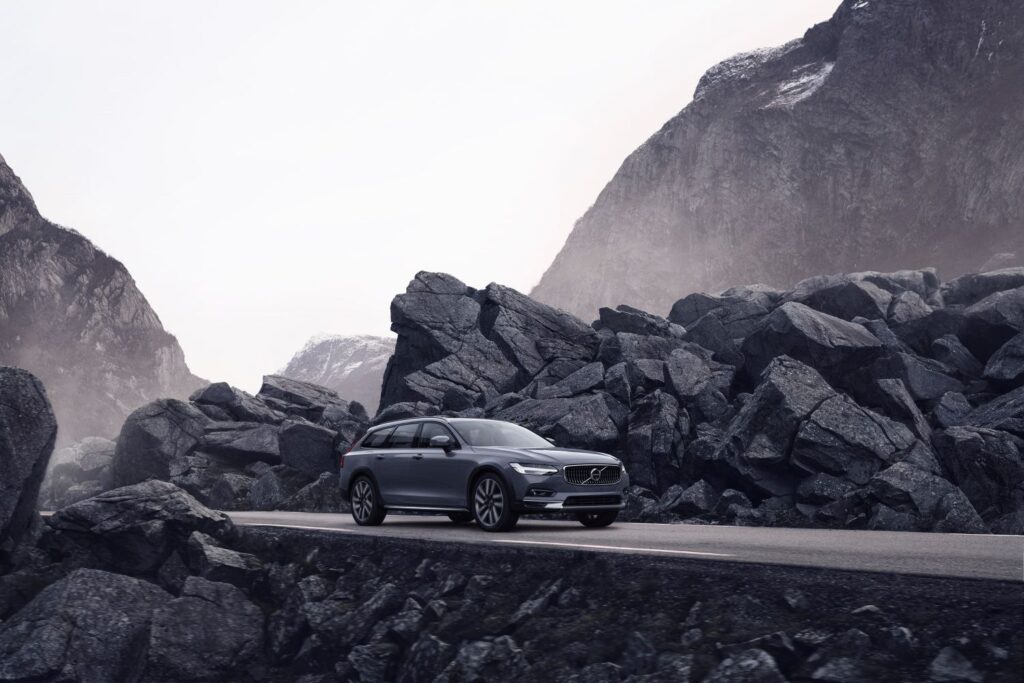
The Volvo V90 Cross Country, particularly the facelifted 2020 model with the 2.0 B4 Diesel (197 Hp) Mild Hybrid AWD Geartronic powertrain, represents a compelling blend of Scandinavian luxury, practical utility, and robust all-road capability. While the V90 Cross Country is available in various markets globally, this specific mild-hybrid diesel variant was primarily tailored for European consumers, where diesel engines with advanced emissions technology and fuel efficiency remain highly relevant. It stands as a sophisticated alternative to traditional SUVs, offering the spaciousness and driving dynamics of a premium station wagon coupled with the raised ground clearance and rugged aesthetics of a crossover. This generation, produced from 2020 to 2024, embodies Volvo’s commitment to safety, environmental responsibility through hybridization, and refined driving experiences, solidifying its position in the competitive executive segment.
Powertrain and Performance of the Volvo V90 Cross Country (facelift 2020)
At the heart of the Volvo V90 Cross Country (facelift 2020) 2.0 B4 Diesel Mild Hybrid AWD Geartronic lies an advanced and efficient powertrain. This particular model integrates a 48-volt mild-hybrid electric vehicle (MHEV) system with a potent 2.0-liter, inline four-cylinder twin-turbo diesel engine, designated D420T8. The internal combustion engine delivers a robust 197 horsepower at 4000 rpm, complemented by a substantial 309.78 lb.-ft. of torque available across a broad rev range from 1750 to 2750 rpm. This impressive torque output ensures strong acceleration and effortless cruising, even with a full load or when towing.
The mild-hybrid system plays a crucial role in enhancing both efficiency and refinement. It features a 48-volt lithium-ion battery and an electric motor capable of producing 14 horsepower and 29.5 lb.-ft. of torque. This electric assistance primarily functions as a power-assist hybrid, providing a torque fill during acceleration, which reduces the load on the diesel engine and improves responsiveness. Furthermore, it enables a smoother and more seamless operation of the Start & Stop System, reducing fuel consumption and emissions in urban driving conditions. The electric motor also assists in energy recuperation during deceleration, recharging the 48V battery.
Performance figures for this powertrain are respectable for its class and intended purpose. The V90 Cross Country can accelerate from 0 to 60 mph in a swift 8.4 seconds, making it agile enough for daily driving and highway merging. Its maximum speed is electronically limited to 111.85 mph, a common practice in many European premium vehicles. Power is routed through an advanced 8-speed Geartronic automatic transmission, renowned for its smooth shifts and intelligent gear selection, optimizing both performance and fuel economy. The All-Wheel Drive (AWD) system is designed for versatility, with the internal combustion engine and electric motor primarily driving the front wheels, and the rear wheels engaging as needed via an electrically or mechanically controlled clutch to provide enhanced traction and stability in varying road conditions.
Fuel efficiency is a significant highlight of this B4 Diesel Mild Hybrid. According to WLTP combined cycle testing, the vehicle achieves an impressive 37.9 to 34.6 US mpg. These figures underscore the effectiveness of the mild-hybrid technology in optimizing diesel efficiency. CO2 emissions range from 163 to 179 g/km, meeting the stringent Euro 6d emission standard, which is critical for its European market positioning. The combination of twin-turbocharging, common rail direct injection, and a DOHC valvetrain ensures precise fuel delivery and combustion, while a particulate filter further reduces harmful emissions, making this a responsible choice for drivers seeking a balance of power, economy, and environmental consideration.
Design, Capability, and Features
The Volvo V90 Cross Country (facelift 2020) embodies Volvo’s distinctive Scandinavian design philosophy, blending elegance with rugged functionality. Its body type is a unique combination of a station wagon (estate) and a crossover, offering the best of both worlds. The facelift introduced subtle enhancements to the exterior styling, maintaining its sophisticated presence while reinforcing its adventurous spirit. Key design elements include a distinctive grille, integrated roof rails, and protective body cladding around the wheel arches and lower body, which not only adds to its robust appearance but also provides practical protection against minor scrapes and debris when venturing off paved roads.
With an overall length of 195.24 inches, a width of 73.98 inches (80.79 inches including mirrors), and a height of 60.51 inches, the V90 Cross Country presents a substantial and commanding stance. Its generous wheelbase of 115.79 inches contributes to a stable ride and a spacious cabin. A defining characteristic of the Cross Country variant is its elevated ride height, offering 7.91 inches of ground clearance, significantly more than the standard V90 wagon. This increased clearance, combined with specific approach (18.9°), departure (20.8°), and ramp-over (17.7°) angles, along with a wading depth of 11.81 inches, equips the vehicle with genuine capability for light off-road excursions and navigating challenging terrain or adverse weather conditions.
Inside, the V90 Cross Country offers a premium and ergonomically designed cabin with seating for five occupants. Volvo’s commitment to comfort and quality is evident in the choice of materials and the intuitive layout of controls. The luggage capacity is highly versatile, providing 19.46 cubic feet (551 liters) with all seats in place, expanding to a cavernous 53.57 cubic feet (1517 liters) when the rear seats are folded down, making it exceptionally practical for families, adventurers, and those with active lifestyles. The maximum load capacity is 1329.39 lbs., further underscoring its utility.
The vehicle’s chassis and suspension are engineered to provide a refined driving experience across various surfaces. It features a double wishbone front suspension with coil springs and a transverse stabilizer, while the rear utilizes a leaf spring setup with a transverse stabilizer, and offers optional air suspension for enhanced comfort and load-leveling capabilities. Braking is handled by ventilated discs both front (345×30 mm) and rear (320×20 mm), ensuring strong and consistent stopping power, assisted by ABS. The electric power steering system provides precise control and good feedback. Standard tire sizes range from 235/50 R19 to optional 245/40 R21, mounted on correspondingly sized wheel rims, contributing to both aesthetics and handling dynamics. As a modern Volvo, it inherently integrates a suite of advanced safety features and driver-assistance systems, though not explicitly detailed in the provided data, these are hallmarks of the brand’s commitment to protecting its occupants.
Detailed Technical Specifications
| Characteristic | Value |
|---|---|
| Brand | Volvo |
| Model | V90 |
| Generation | V90 Cross Country (facelift 2020) |
| Type (Engine) | 2.0 B4 Diesel (197 Hp) Mild Hybrid AWD Geartronic |
| Start of production | 2020 year |
| End of production | 2024 year |
| Powertrain Architecture | MHEV (Mild Hybrid Electric Vehicle) |
| Body type | Station wagon (estate), Crossover |
| Seats | 5 |
| Doors | 5 |
| Fuel consumption at Low speed (WLTP) | 7.9-8.4 l/100 km (29.8 – 28 US mpg) |
| Fuel consumption at Medium speed (WLTP) | 6.3-7 l/100 km (37.3 – 33.6 US mpg) |
| Fuel consumption at High speed (WLTP) | 5.4-5.8 l/100 km (43.6 – 40.6 US mpg) |
| Fuel consumption at Very High speed (WLTP) | 6.3-7.1 l/100 km (37.3 – 33.1 US mpg) |
| Combined fuel consumption (WLTP) | 6.2-6.8 l/100 km (37.9 – 34.6 US mpg) |
| CO2 emissions (WLTP) | 163-179 g/km |
| Fuel consumption (economy) – urban (NEDC) | 6.2-6.5 l/100 km (37.9 – 36.2 US mpg) |
| Fuel consumption (economy) – extra urban (NEDC) | 4.8-4.9 l/100 km (49 – 48 US mpg) |
| Fuel consumption (economy) – combined (NEDC) | 5.3-5.5 l/100 km (44.4 – 42.8 US mpg) |
| CO2 emissions (NEDC) | 140-144 g/km |
| Fuel Type | Diesel |
| Acceleration 0 – 62 mph | 8.8 sec |
| Acceleration 0 – 60 mph (Calculated) | 8.4 sec |
| Maximum speed | 180 km/h (111.85 mph, Electronically limited) |
| Braking distance 100 km/h – 0 | 35 m |
| Emission standard | Euro 6d |
| Weight-to-power ratio | 9.7 kg/Hp (103.3 Hp/tonne) |
| Weight-to-torque ratio | 4.5 kg/Nm (220.2 Nm/tonne) |
| Battery voltage | 48 V |
| Battery technology | Lithium-ion (Li-Ion) |
| Electric motor power | 14 Hp |
| Electric motor Torque | 40 Nm (29.5 lb.-ft.) |
| Power | 197 Hp @ 4000 rpm |
| Power per liter | 100.1 Hp/l |
| Torque | 420 Nm @ 1750-2750 rpm (309.78 lb.-ft.) |
| Maximum engine speed | 5000 rpm |
| Engine layout | Front, Transverse |
| Engine Model/Code | D420T8 |
| Engine displacement | 1969 cm3 (120.16 cu. in.) |
| Number of cylinders | 4 |
| Engine configuration | Inline |
| Cylinder Bore | 82 mm (3.23 in.) |
| Piston Stroke | 93.2 mm (3.67 in.) |
| Compression ratio | 15.8:1 |
| Number of valves per cylinder | 4 |
| Fuel injection system | Diesel Commonrail |
| Engine aspiration | Twin-Turbo, Intercooler |
| Valvetrain | DOHC |
| Engine oil capacity | 5.6 l (5.92 US qt) |
| Engine systems | Start & Stop System, Particulate filter |
| Kerb Weight | 1907 kg (4204.22 lbs.) |
| Max. weight (Gross Vehicle Weight) | 2510 kg (5533.6 lbs.) |
| Max load | 603 kg (1329.39 lbs.) |
| Trunk (boot) space – minimum | 551 l (19.46 cu. ft.) |
| Trunk (boot) space – maximum | 1517 l (53.57 cu. ft.) |
| Fuel tank capacity | 71 l (18.76 US gal) |
| AdBlue tank | 11.5 l (3.04 US gal) |
| Max. roof load | 100 kg (220.46 lbs.) |
| Permitted trailer load with brakes (12%) | 2400 kg (5291.09 lbs.) |
| Permitted trailer load without brakes | 750 kg (1653.47 lbs.) |
| Permitted towbar download | 100 kg (220.46 lbs.) |
| Length | 4959 mm (195.24 in.) |
| Width | 1879 mm (73.98 in.) |
| Width with mirrors folded | 1929 mm (75.94 in.) |
| Width including mirrors | 2052 mm (80.79 in.) |
| Height | 1537 mm (60.51 in.) |
| Wheelbase | 2941 mm (115.79 in.) |
| Front track | 1652-1655 mm (65.04 – 65.16 in.) |
| Rear (Back) track | 1643-1645 mm (64.69 – 64.76 in.) |
| Front overhang | 893 mm (35.16 in.) |
| Rear overhang | 1125 mm (44.29 in.) |
| Ride height (ground clearance) | 201 mm (7.91 in.) |
| Drag coefficient (Cd) | 0.35-0.37 |
| Minimum turning circle (turning diameter) | 12 m (39.37 ft.) |
| Approach angle | 18.9° |
| Departure angle | 20.8° |
| Ramp-over (brakeover) angle | 17.7° |
| Wading depth | 300 mm (11.81 in.) |
| Drivetrain Architecture | ICE and electric motor permanently drive front wheels, rear wheels driven via clutch as needed. |
| Drive wheel | All wheel drive (4×4) |
| Number of gears and type of gearbox | 8 gears, automatic transmission Geartronic |
| Front suspension | Coil spring, Double wishbone, Transverse stabilizer |

