
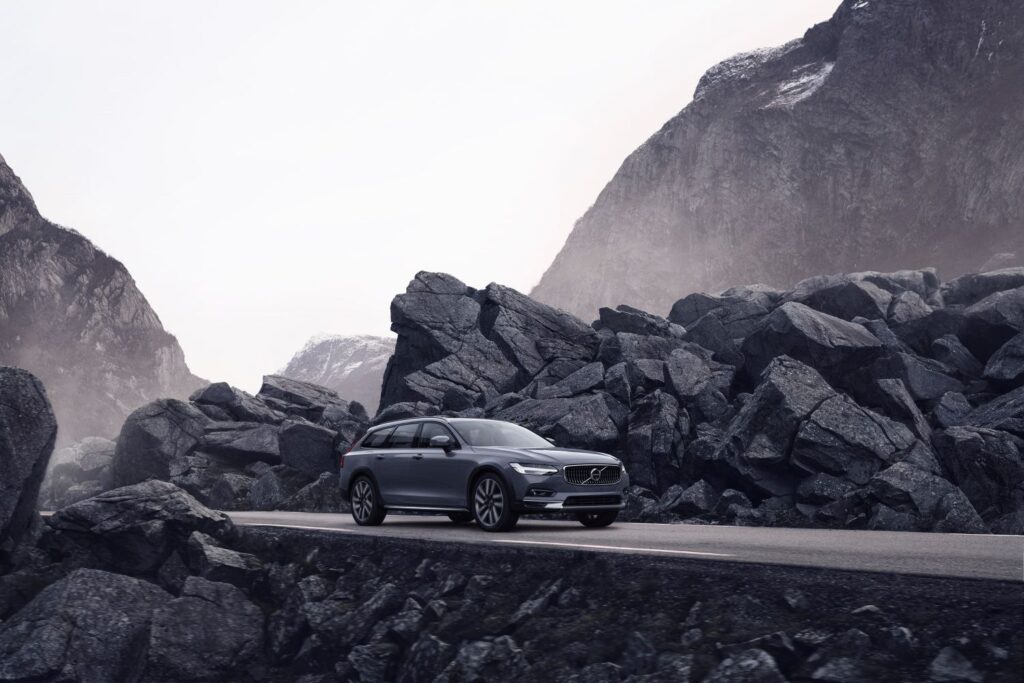
The Volvo V90 Cross Country (facelift 2020) represents a compelling blend of Scandinavian luxury, robust capability, and advanced mild-hybrid technology. Positioned as a premium all-wheel-drive station wagon with distinct crossover attributes, this vehicle caters to a discerning European and global market that values versatility and understated elegance over the more conventional SUV form factor. The 2020 facelift introduced a series of refinements, most notably the integration of a B5 mild-hybrid powertrain, underscoring Volvo’s steadfast commitment to electrification and enhanced efficiency across its model range. This generation of the V90 Cross Country builds upon a strong heritage of practical yet sophisticated wagons, offering a unique proposition that combines the driving dynamics and comfort of a sedan with the elevated ground clearance and rugged aesthetics of an off-road capable vehicle. It stands as a testament to Volvo’s core values: safety, environmental stewardship, and a design philosophy rooted in human-centric engineering.
Engine & Performance: The B5 Mild Hybrid Powertrain in the Volvo V90 Cross Country (facelift 2020)
At the heart of the Volvo V90 Cross Country (facelift 2020) 2.0 B5 is a sophisticated Mild Hybrid Electric Vehicle (MHEV) powertrain, meticulously engineered to deliver a balance of robust performance and commendable fuel efficiency. This MHEV system, often referred to as a power-assist or battery-assisted hybrid, integrates a potent internal combustion engine with an electric motor to reduce fuel consumption and emissions. The primary internal combustion unit is a 2.0-liter (120.16 cubic inches) inline four-cylinder gasoline engine, featuring direct injection, a turbocharger, and an intercooler for optimal air charge density. This advanced engine, identified by the model code B420T2, produces a healthy 250 horsepower at a broad range of 5400-5700 rpm, translating to an impressive 127 horsepower per liter. Peak torque stands at 258.15 lb.-ft., available across a wide and accessible band from 1800-4800 rpm, ensuring strong acceleration and flexible passing power.
Complementing the gasoline engine is an electric motor contributing 14 horsepower and 29.5 lb.-ft. of torque. While not capable of propelling the vehicle solely on electric power for extended distances, this motor plays a crucial role in the mild-hybrid system. It assists the engine during acceleration, providing a torque boost that smooths out power delivery and reduces the workload on the gasoline engine, particularly during initial take-off. The system also enables more seamless operation of the Start & Stop function, further contributing to fuel savings in urban environments. Power is seamlessly managed by an 8-speed Geartronic automatic transmission, renowned for its smooth shifts and intelligent gear selection. The drivetrain architecture is a permanent all-wheel-drive (AWD) system, where both the internal combustion engine and the electric motor primarily drive the front wheels. When conditions necessitate, an electrically or mechanically controlled clutch engages the rear wheels, ensuring optimal traction and stability across varying road surfaces and weather conditions. This intelligent AWD system, combined with the mild-hybrid powertrain, provides confidence and capability.
Performance figures for the V90 Cross Country are respectable for its class and size. The vehicle accelerates from 0 to 60 mph in a swift 7.0 seconds, with 0-100 km/h achieved in 7.4 seconds. The top speed is electronically limited to 111.85 mph (180 km/h), a common practice among modern Volvos prioritizing safety and efficiency. Fuel economy is a key highlight, with a combined WLTP rating of 31.4 – 28.3 US mpg (7.5-8.3 l/100 km). CO2 emissions are reported between 170-188 g/km (WLTP), demonstrating the effectiveness of the mild-hybrid system in reducing the vehicle’s environmental footprint. The car also meets the stringent Euro 6d emission standard, underscoring its clean operation. Beyond the powertrain, the vehicle features disc brakes on both the front (345 mm) and rear, complemented by an Anti-lock Braking System (ABS) for assured stopping power, with a 100 km/h to 0 stopping distance of 35 meters. The electric power steering system, a rack and pinion type, offers precise control and responsive feedback.
Design & Features: Scandinavian Practicality and Rugged Elegance
The Volvo V90 Cross Country (facelift 2020) elegantly merges the practicality of a station wagon (estate) with the adventurous spirit of a crossover, creating a distinctive body type that stands out in the automotive landscape. Its design is a testament to Volvo’s contemporary aesthetic, characterized by clean lines, sophisticated proportions, and a purposeful stance. The “Cross Country” designation is visually reinforced by several key elements: an elevated ride height of 8.27 inches (210 mm) provides enhanced ground clearance for navigating uneven terrain, while protective body cladding around the wheel arches and lower body panels guards against scrapes and impacts. The front and rear bumpers also feature unique designs that convey a more rugged and adventurous persona, complemented by specific grille treatments and integrated roof rails for added utility.
Inside, the V90 Cross Country offers a sanctuary of Scandinavian design and comfort. The cabin is configured for five occupants across five doors, providing ample space and a premium atmosphere. Materials are of high quality, with a focus on sustainable and tactile finishes. Volvo’s commitment to ergonomics is evident in the thoughtfully laid-out controls and supremely comfortable seating. Practicality is a hallmark of the wagon body style, and the V90 Cross Country excels in this regard. The trunk (boot) offers a substantial 19.78 cubic feet (560 liters) of cargo space with all seats in place, expanding to an impressive 53.89 cubic feet (1526 liters) when the rear seats are folded down, making it highly adaptable for various cargo needs. A fuel tank capacity of 15.85 US gallons (60 liters) ensures a generous cruising range.
Beyond its aesthetic appeal and practicality, the V90 Cross Country is engineered for versatility and capability. Its chassis incorporates a double wishbone front suspension with a transverse stabilizer, providing precise handling and ride comfort. At the rear, the suspension features a transverse stabilizer and a leaf spring setup, which, in modern Volvo applications, is often a composite leaf spring designed for compact packaging and optimized ride characteristics. These elements, combined with the robust AWD system, contribute to the vehicle’s confident road manners and ability to tackle light off-road excursions. The vehicle’s off-road credentials are further highlighted by its approach angle of 19 degrees, a departure angle of 20.7 degrees, a ramp-over (brakeover) angle of 17.7 degrees, and a wading depth of 11.81 inches (300 mm). These specifications denote a genuine capacity for venturing beyond paved roads. The vehicle’s turning circle is a manageable 39.37 feet (12.0 meters), aiding maneuverability in tighter spaces. Wheel rim options range from 18 to 21 inches, allowing for personalization and varying degrees of style and performance. As with all Volvos, safety is paramount, and the V90 Cross Country includes fundamental safety features like ABS, with the expectation of a comprehensive suite of advanced driver-assistance systems characteristic of the brand, even if not explicitly detailed in all data points.
Technical Specifications
| Brand | Volvo |
| Model | V90 |
| Generation | V90 Cross Country (facelift 2020) |
| Type (Engine) | 2.0 B5 (250 Hp) Mild Hybrid AWD Automatic |
| Start of production | 2020 year |
| Powertrain Architecture | MHEV (Mild Hybrid Electric Vehicle, power-assist hybrid, battery-assisted hybrid vehicles, BAHV) |
| Body type | Station wagon (estate), Crossover |
| Seats | 5 |
| Doors | 5 |
| Combined fuel consumption (WLTP) | 7.5-8.3 l/100 km (31.4 – 28.3 US mpg) |
| CO2 emissions (WLTP) | 170-188 g/km |
| Fuel consumption (economy) – combined (NEDC) | 6.7-6.8 l/100 km (35.1 – 34.6 US mpg) |
| CO2 emissions (NEDC) | 151-154 g/km |
| Fuel Type | Petrol (Gasoline) |
| Acceleration 0 – 100 km/h | 7.4 sec |
| Acceleration 0 – 62 mph | 7.4 sec |
| Acceleration 0 – 60 mph (Calculated) | 7 sec |
| Maximum speed | 180 km/h (111.85 mph) |
| 100 km/h – 0 braking distance | 35 m |
| Emission standard | Euro 6d |
| Electric motor power | 14 Hp |
| Electric motor Torque | 40 Nm (29.5 lb.-ft.) |
| Power | 250 Hp @ 5400-5700 rpm |
| Power per liter | 127 Hp/l |
| Torque | 350 Nm @ 1800-4800 rpm (258.15 lb.-ft. @ 1800-4800 rpm) |
| Maximum engine speed | 6200 rpm |
| Engine layout | Front, Transverse |
| Engine Model/Code | B420T2 |
| Engine displacement | 1969 cm3 (120.16 cu. in.) |
| Number of cylinders | 4 |
| Engine configuration | Inline |
| Cylinder Bore | 82 mm (3.23 in.) |
| Piston Stroke | 93.2 mm (3.67 in.) |
| Compression ratio | 10.5:1 |
| Number of valves per cylinder | 4 |
| Fuel injection system | Direct injection |
| Engine aspiration | Turbocharger, Intercooler |
| Valvetrain | DOHC |
| Engine oil capacity | 6.1 l (6.45 US qt) |
| Engine oil specification | Not specified |
| Engine systems | Start & Stop System, Particulate filter |
| Trunk (boot) space – minimum | 560 l (19.78 cu. ft.) |
| Trunk (boot) space – maximum | 1526 l (53.89 cu. ft.) |
| Fuel tank capacity | 60 l (15.85 US gal) |
| Max. roof load | 100 kg (220.46 lbs.) |
| Permitted trailer load with brakes (12%) | 2400 kg (5291.09 lbs.) |
| Permitted trailer load without brakes | 750 kg (1653.47 lbs.) |
| Front track | 1652-1655 mm (65.04 – 65.16 in.) |
| Rear (Back) track | 1643-1645 mm (64.69 – 64.76 in.) |
| Ride height (ground clearance) | 210 mm (8.27 in.) |
| Drag coefficient (Cd) | 0.35-0.37 |
| Minimum turning circle (turning diameter) | 12.0 m (39.37 ft.) |
| Approach angle | 19° |
| Departure angle | 20.7° |
| Ramp-over (brakeover) angle | 17.7° |
| Wading depth | 300 mm (11.81 in.) |
| Drivetrain Architecture | ICE and electric motor permanently drive front wheels, capable of running in mixed mode, rear wheels driven via electrically or mechanically controlled clutch if necessary. |
| Drive wheel | All wheel drive (4×4) |
| Number of gears and type of gearbox | 8 gears, automatic transmission Geartronic |
| Front suspension | Double wishbone, Transverse stabilizer |
| Rear suspension | Transverse stabilizer, Leaf spring |
| Front brakes | Disc, 345 mm |
| Rear brakes | Disc |
| Assisting systems | ABS (Anti-lock braking system) |
| Steering type | Steering rack and pinion |
| Power steering | Electric Steering |
| Wheel rims size | 18; 19; 20; 21 |

