
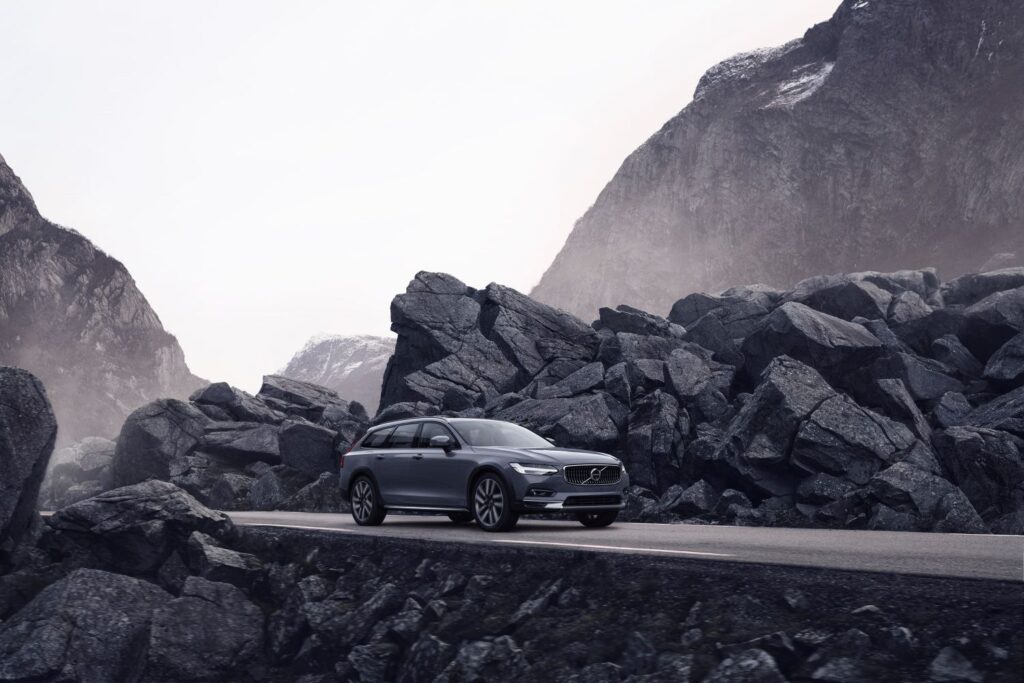
The Volvo V90 Cross Country (facelift 2020) represents a compelling blend of Scandinavian design, robust capability, and advanced powertrain technology, positioning itself as a sophisticated premium crossover wagon. This particular iteration, featuring the 2.0 B5 Diesel (235 Hp) Mild Hybrid AWD Geartronic powertrain, was produced from June 2020 to 2022, primarily targeting European and other international markets where diesel engines, especially those with mild-hybrid assistance, remain a popular and efficient choice for long-distance driving and towing. Building upon the V90’s elegant estate car foundation, the Cross Country variant elevates its stance and rugged appeal, offering enhanced versatility and all-weather capability without compromising on the luxurious comfort and safety synonymous with the Volvo brand. This facelifted model integrates subtle aesthetic refinements and technological updates, ensuring its continued relevance in a competitive segment that values both practicality and prestige.
Powertrain and Performance of the Volvo V90 Cross Country (facelift 2020)
At the heart of the Volvo V90 Cross Country (facelift 2020) B5 Diesel model is a sophisticated 2.0-liter inline four-cylinder engine, designated D420T2, which benefits from twin-turbocharging and an intercooler to deliver robust performance. This internal combustion engine produces a formidable 235 horsepower at 4000 rpm, translating to a power-per-liter output of 119.3 Hp/l. Torque figures are equally impressive, peaking at 354 lb.-ft. (480 Nm) across a broad range from 1750 to 2250 rpm, ensuring strong acceleration and effortless cruising. The engine features a DOHC valvetrain, a compression ratio of 15.8:1, and a common rail diesel fuel injection system, all optimized for efficiency and power delivery. To meet stringent Euro 6d emission standards, the engine incorporates a Start & Stop system and a particulate filter, alongside an AdBlue tank with an 11.5-liter capacity.
Crucially, this B5 powertrain is a Mild Hybrid Electric Vehicle (MHEV) architecture, employing a 48-volt lithium-ion battery and an integrated starter generator (ISG) motor. This electric motor contributes an additional 14 horsepower and 29.5 lb.-ft. (40 Nm) of torque, primarily assisting the internal combustion engine during acceleration and enhancing the efficiency of the Start & Stop system. The MHEV system captures kinetic energy through regenerative braking, storing it in the 48V battery to power the vehicle’s electrical systems and provide a subtle power boost, thereby reducing fuel consumption and CO2 emissions. This seamless integration allows the powertrain to operate in a mixed mode, with the ICE and electric motor permanently driving the front wheels, and the rear wheels engaging via an electrically or mechanically controlled clutch when needed, ensuring optimal traction through the All-Wheel Drive (AWD) system.
Power is managed by an advanced 8-speed Geartronic automatic transmission, renowned for its smooth shifts and intelligent gear selection. This combination propels the V90 Cross Country from 0 to 60 mph in a swift 7.1 seconds (0-100 km/h in 7.5 seconds), a commendable feat for a vehicle of its size and weight. The top speed is electronically limited to 111.85 mph (180 km/h), a common practice for modern European vehicles prioritizing safety and efficiency. Fuel economy is a strong suit for this diesel mild-hybrid, with a combined WLTP rating of 34.6 to 37.9 US mpg (6.2-6.8 l/100 km) and combined NEDC equivalent figures reaching 42.8 to 44.4 US mpg (5.3-5.5 l/100 km). These figures highlight the effectiveness of the mild-hybrid system in optimizing fuel usage across various driving conditions, making it an economically sensible choice for drivers covering significant mileage.
Design, Capability, and Advanced Features
The Volvo V90 Cross Country (facelift 2020) stands out with its distinctive body type, merging the practicality of a station wagon (estate) with the adventurous spirit of a crossover. Its design ethos reflects Volvo’s commitment to understated elegance and functional utility. Measuring 195.24 inches (4959 mm) in length, 73.98 inches (1879 mm) in width (80.79 inches or 2052 mm including mirrors), and 60.51 inches (1537 mm) in height, the V90 Cross Country commands a substantial road presence. The extended wheelbase of 115.79 inches (2941 mm) contributes to both interior spaciousness and a composed ride.
A key differentiator for the Cross Country model is its elevated ride height, boasting a ground clearance of 7.91 inches (201 mm). This, combined with specific approach (18.9°), departure (20.8°), and ramp-over (17.7°) angles, enhances its capability on unpaved roads and through challenging terrain. The vehicle also features a wading depth of 11.81 inches (300 mm), further underscoring its readiness for varied adventures. The exterior design is characterized by protective body cladding, unique front and rear fascias, and standard roof rails, all contributing to its rugged yet refined aesthetic. The drag coefficient ranges from 0.35 to 0.37, balancing its robust form with aerodynamic efficiency.
Inside, the V90 Cross Country offers a premium cabin experience for five occupants across its five doors. Volvo’s reputation for ergonomic design and high-quality materials is evident throughout. Practicality is a hallmark, with a generous trunk space ranging from 19.46 cu. ft. (551 liters) with all seats in place, expanding to a cavernous 53.57 cu. ft. (1517 liters) with the rear seats folded, making it highly suitable for families, outdoor enthusiasts, or those requiring substantial cargo capacity. The fuel tank capacity is 18.76 US gallons (71 liters), providing an excellent range in conjunction with the efficient diesel mild-hybrid powertrain.
The chassis and suspension systems are engineered for both comfort and capability. The front features a coil spring, double wishbone setup with a transverse stabilizer, while the rear utilizes a transverse stabilizer and a leaf spring, with an optional air suspension system available for enhanced ride comfort and load leveling. Braking is handled by ventilated discs both front (345×30 mm) and rear (320×20 mm), complemented by an Anti-lock Braking System (ABS) for assured stopping power. Steering is an electric rack and pinion system, providing precise control and ease of maneuverability, with a minimum turning circle of 39.37 feet (12 meters). The vehicle is equipped with various tire sizes, including 235/50 R19, 245/45 R20, and 245/40 R21, mounted on correspondingly sized wheel rims (7.5J x 19, 8J x 20, 8J x 21), allowing for customization in terms of aesthetics and dynamic performance. The V90 Cross Country also boasts a significant towing capacity, rated at 5291.09 lbs. (2400 kg) with brakes, further enhancing its utility.
Technical Specifications
Below is a detailed table outlining the technical specifications for the Volvo V90 Cross Country (facelift 2020) 2.0 B5 Diesel (235 Hp) Mild Hybrid AWD Geartronic model.
| Brand | Volvo |
| Model | V90 |
| Generation | V90 Cross Country (facelift 2020) |
| Type (Engine) | 2.0 B5 Diesel (235 Hp) Mild Hybrid AWD Geartronic |
| Start of production | June, 2020 |
| End of production | 2022 |
| Powertrain Architecture | MHEV (Mild Hybrid Electric Vehicle) |
| Body type | Station wagon (estate), Crossover |
| Seats | 5 |
| Doors | 5 |
| Fuel consumption at Low speed (WLTP) | 7.9-8.4 l/100 km (29.8 – 28 US mpg) |
| Fuel consumption at Medium speed (WLTP) | 6.2-7 l/100 km (37.9 – 33.6 US mpg) |
| Fuel consumption at High speed (WLTP) | 5.3-5.8 l/100 km (44.4 – 40.6 US mpg) |
| Fuel consumption at Very High speed (WLTP) | 6.3-7.1 l/100 km (37.3 – 33.1 US mpg) |
| Combined fuel consumption (WLTP) | 6.2-6.8 l/100 km (37.9 – 34.6 US mpg) |
| CO2 emissions (WLTP) | 162-179 g/km |
| Fuel consumption (economy) – urban (NEDC) | 6.2-6.5 l/100 km (37.9 – 36.2 US mpg) |
| Fuel consumption (economy) – extra urban (NEDC) | 4.8-4.9 l/100 km (49 – 48 US mpg) |
| Fuel consumption (economy) – combined (NEDC) | 5.3-5.5 l/100 km (44.4 – 42.8 US mpg) |
| CO2 emissions (NEDC) | 140-144 g/km |
| Fuel Type | Diesel |
| Acceleration 0 – 60 mph (Calculated) | 7.1 sec |
| Acceleration 0 – 100 km/h | 7.5 sec |
| Maximum speed | 111.85 mph (180 km/h, Electronically limited) |
| Braking distance 100 km/h – 0 | 35 m |
| Emission standard | Euro 6d |
| Weight-to-power ratio | 8.1 kg/Hp (123.2 Hp/tonne) |
| Weight-to-torque ratio | 4 kg/Nm (251.7 Nm/tonne) |
| Battery voltage | 48 V |
| Battery technology | Lithium-ion (Li-Ion) |
| Electric motor power | 14 Hp |
| Electric motor Torque | 29.5 lb.-ft. (40 Nm) |
| Power | 235 Hp @ 4000 rpm |
| Power per liter | 119.3 Hp/l |
| Torque | 354.03 lb.-ft. (480 Nm @ 1750-2250 rpm) |
| Maximum engine speed | 5000 rpm |
| Engine layout | Front, Transverse |
| Engine Model/Code | D420T2 |
| Engine displacement | 120.16 cu. in. (1969 cm3) |
| Number of cylinders | 4 |
| Engine configuration | Inline |
| Cylinder Bore | 3.23 in. (82 mm) |
| Piston Stroke | 3.67 in. (93.2 mm) |
| Compression ratio | 15.8:1 |
| Number of valves per cylinder | 4 |
| Fuel injection system | Diesel Commonrail |
| Engine aspiration | Twin-Turbo, Intercooler |
| Valvetrain | DOHC |
| Engine oil capacity | 5.92 US qt (5.6 l) |
| Engine systems | Start & Stop System, Particulate filter |
| Kerb Weight | 4204.22 lbs. (1907 kg) |
| Max. weight | 5533.6 lbs. (2510 kg) |
| Max load | 1329.39 lbs. (603 kg) |
| Trunk (boot) space – minimum | 19.46 cu. ft. (551 l) |
| Trunk (boot) space – maximum | 53.57 cu. ft. (1517 l) |
| Fuel tank capacity | 18.76 US gal (71 l) |
| AdBlue tank | 3.04 US gal (11.5 l) |
| Max. roof load | 220.46 lbs. (100 kg) |
| Permitted trailer load with brakes (12%) | 5291.09 lbs. (2400 kg) |
| Permitted trailer load without brakes | 1653.47 lbs. (750 kg) |
| Permitted towbar download | 220.46 lbs. (100 kg) |
| Length | 195.24 in. (4959 mm) |
| Width | 73.98 in. (1879 mm) |
| Width with mirrors folded | 75.94 in. (1929 mm) |
| Width including mirrors | 80.79 in. (2052 mm) |
| Height | 60.51 in. (1537 mm) |
| Wheelbase | 115.79 in. (2941 mm) |
| Front track | 65.04 – 65.16 in. (1652-1655 mm) |
| Rear (Back) track | 64.69 – 64.76 in. (1643-1645 mm) |
| Front overhang | 35.16 in. (893 mm) |
| Rear overhang | 44.29 in. (1125 mm) |
| Ride height (ground clearance) | 7.91 in. (201 mm) |
| Drag coefficient (Cd) | 0.35-0.37 |
| Minimum turning circle (turning diameter) | 39.37 ft. (12 m) |
| Approach angle | 18.9° |
| Departure angle | 20.8° |
| Ramp-over (brakeover) angle | 17.7° |
| Wading depth | 11.81 in. (300 mm) |
| Drivetrain Architecture | ICE and electric motor permanently drive front wheels; rear wheels driven via clutch if necessary. |
| Drive wheel | All wheel drive (4×4) |
| Number of gears and type of gearbox | 8 gears, automatic transmission Geartronic |
| Front suspension | Coil spring, Double wishbone, Transverse stabilizer |
| Rear suspension | Transverse stabilizer, Leaf spring, Air Suspension – Optional |
| Front brakes | Ventilated discs, 345×30 mm |
| Rear brakes | Ventilated discs, 320×20 mm |
| Assisting systems | ABS (Anti-lock braking system) |
| Steering type | Steering rack and pinion |
| Power steering | Electric Steering |
| Tires size | 235/50 R19; 245/45 R20; 245/40 R21 |
| Wheel rims size | 7.5J x 19; 8J x 20; 8J x 21 |

