
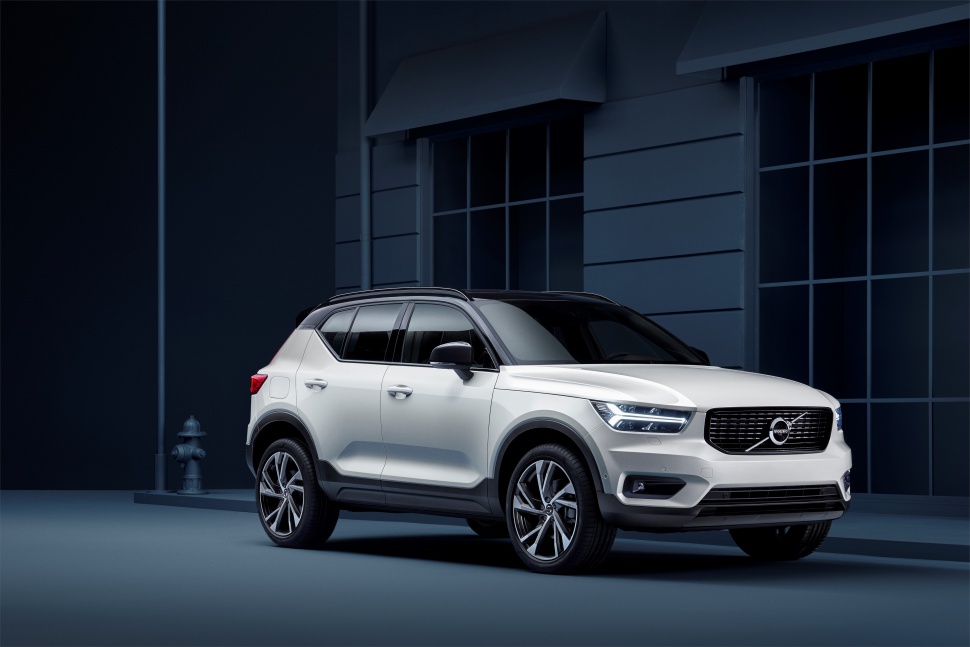
The Volvo XC40, a significant entry in the compact luxury SUV segment, made its debut as a compelling option for discerning drivers seeking a blend of Scandinavian design, robust safety features, and practical versatility. The variant under review, the Volvo XC40 2.0 D3 (150 Hp) Automatic, represents a key powertrain option primarily offered in European and other international markets, distinct from the gasoline-centric lineup more common in North America. Launched in March 2018 and produced until June 2020, this specific iteration of the XC40 showcased Volvo’s commitment to efficient diesel propulsion alongside its premium compact SUV architecture. As the first model built on Volvo’s Compact Modular Architecture (CMA) platform, the XC40 was designed from the ground up to challenge established rivals with its distinctive styling, intelligent packaging, and a strong emphasis on urban usability.
The Volvo XC40 2.0 D3 (150 Hp) Automatic: Powertrain and Performance
At the heart of the Volvo XC40 2.0 D3 (150 Hp) Automatic lies a sophisticated 2.0-liter (1969 cm³, 120.16 cu. in.) inline four-cylinder diesel engine, designated with the model code D4204T16. This powerplant is engineered for a balance of power, torque, and fuel efficiency, making it an attractive choice for markets where diesel remains a popular and practical fuel option. The engine produces a respectable 150 horsepower at 3750 revolutions per minute, delivering robust acceleration and sustained cruising capability. More notably, it generates a substantial 350 Newton-meters (258.15 lb.-ft.) of torque across a broad rev range, from 1800 to 4800 rpm. This wide torque band is characteristic of modern diesel engines, providing excellent responsiveness and effortless performance in everyday driving scenarios, from city commuting to highway merging.
Power is seamlessly transferred to the front wheels via an advanced 8-speed automatic transmission. This gearbox is precisely calibrated to optimize both performance and fuel economy, executing smooth and timely shifts. The D3 powertrain enables the XC40 to accelerate from 0 to 62 miles per hour (0-100 km/h) in 10.2 seconds, with an estimated 0-60 mph time of 9.7 seconds, and reach a maximum speed of 124.27 mph (200 km/h). While not a performance-oriented variant, these figures are more than adequate for a compact SUV designed for family and urban use, offering confident progress on highways and through city traffic.
Fuel efficiency is a significant advantage of the 2.0 D3 engine, particularly when compared to gasoline counterparts. According to the WLTP (Worldwide Harmonized Light Vehicles Test Procedure) cycle, the combined fuel consumption ranges from 6.0 to 6.3 liters per 100 kilometers, which translates to an impressive 39.2 to 37.3 US miles per gallon. Under the older NEDC (New European Driving Cycle) combined test, the figures were even more favorable at 5.1 l/100 km (46.1 US mpg). Urban consumption was rated at 5.8 l/100 km (40.6 US mpg), while extra-urban driving could achieve 4.7 l/100 km (50 US mpg). These figures underscore the diesel engine’s inherent efficiency, particularly on longer journeys. Correspondingly, CO2 emissions are kept in check, with WLTP figures between 156-165 g/km and NEDC at 129 g/km, meeting the stringent Euro 6 emission standard thanks to advanced diesel common rail injection and a particulate filter system.
Design, Features, and Practicality
The Volvo XC40 distinguishes itself with a bold and contemporary design language that marries Scandinavian minimalism with a robust SUV stance. As a 5-door, 5-seat SUV, it projects a youthful yet sophisticated image, characterized by its distinctive “Thor’s Hammer” LED headlights, a prominent grille, and a sculpted body that conveys strength and agility. The compact dimensions, with a length of 174.21 inches (4425 mm), a width of 73.35 inches (1863 mm, or 80.08 inches including mirrors), and a height of 65.04 inches (1652 mm), make it highly maneuverable in urban environments while still offering a commanding presence.
Inside, the XC40’s cabin exemplifies Volvo’s commitment to ergonomic design, high-quality materials, and intelligent storage solutions. Although specific interior features are not detailed in the provided data, the XC40 generally offers a premium experience with intuitive infotainment systems, comfortable seating, and a strong emphasis on driver and passenger well-being. Volvo’s reputation for safety is paramount, and the XC40, even in this D3 variant, would have come equipped with a comprehensive suite of active and passive safety technologies, reflecting the brand’s pioneering efforts in accident prevention and occupant protection. These typically include advanced driver-assistance systems (ADAS) that go beyond the standard ABS listed in the technical data.
Practicality is a cornerstone of the XC40’s appeal. The vehicle offers a generous trunk space of 460 liters (16.24 cu. ft.), which is competitive for its class, providing ample room for luggage, groceries, or sports equipment. Its curb weight of 3683.92 lbs. (1671 kg) contributes to a solid road feel, while a maximum permissible weight of 4806.08 lbs. (2180 kg) indicates a substantial payload capacity of 1122.15 lbs. (509 kg). Furthermore, the XC40 2.0 D3 Automatic boasts a permitted trailer load with brakes of 3968.32 lbs. (1800 kg), making it capable of towing a variety of trailers, from small utility trailers to recreational vehicles, enhancing its versatility for active lifestyles.
Chassis, Drivetrain, and Safety Systems
The Volvo XC40 is underpinned by a robust chassis designed to deliver a refined and engaging driving experience. Its drivetrain architecture features a front-engine, transverse layout, with power exclusively directed to the front wheels. This front-wheel-drive (FWD) configuration, while differing from the all-wheel-drive options available on other XC40 variants, contributes to better fuel efficiency and lighter weight, which can be advantageous in many driving conditions.
The suspension system is engineered for comfort and dynamic stability. The front utilizes an independent McPherson strut setup with coil springs and an anti-roll bar, a common and effective design for precise steering and good road holding. The rear suspension features an independent coil spring arrangement, further contributing to ride comfort and stability. This combination ensures that the XC40 handles predictably, absorbing road imperfections while maintaining composure during cornering.
Braking performance is managed by ventilated discs at the front and solid discs at the rear, providing strong and consistent stopping power. An Anti-lock Braking System (ABS) is standard, preventing wheel lock-up during hard braking and maintaining steering control. Steering is handled by a rack and pinion system, complemented by electric power steering, which offers precise control and light effort at low speeds for easy maneuvering, while firming up at higher speeds for enhanced stability. The minimum turning circle of 37.4 feet (11.4 meters) highlights its urban agility, allowing for easy navigation through tight streets and parking lots. Overall, the XC40’s chassis and drivetrain components are meticulously engineered to deliver a safe, comfortable, and confident driving experience, consistent with Volvo’s reputation for engineering excellence.
Technical Specifications: Volvo XC40 2.0 D3 (150 Hp) Automatic
| General Information | |
| Brand | Volvo |
| Model | XC40 |
| Generation | XC40 |
| Type (Engine) | 2.0 D3 (150 Hp) Automatic |
| Start of Production | March, 2018 year |
| End of Production | June, 2020 year |
| Powertrain Architecture | Internal Combustion engine |
| Body type | SUV |
| Seats | 5 |
| Doors | 5 |
| Performance Specs | |
| Fuel consumption at Low speed (WLTP) | 7.6-8.0 l/100 km (30.9 – 29.4 US mpg) |
| Fuel consumption at Medium speed (WLTP) | 6.0-6.2 l/100 km (39.2 – 37.9 US mpg) |
| Fuel consumption at High speed (WLTP) | 5.0-5.4 l/100 km (47 – 43.6 US mpg) |
| Fuel consumption at Very High speed (WLTP) | 6.4-6.8 l/100 km (36.8 – 34.6 US mpg) |
| Combined fuel consumption (WLTP) | 6.0-6.3 l/100 km (39.2 – 37.3 US mpg) |
| CO2 emissions (WLTP) | 156-165 g/km |
| Fuel consumption (economy) – urban | 5.8 l/100 km (40.6 US mpg) |
| Fuel consumption (economy) – extra urban | 4.7 l/100 km (50 US mpg) |
| Fuel consumption (economy) – combined | 5.1 l/100 km (46.1 US mpg) |
| CO2 emissions (NEDC) | 129 g/km |
| Fuel Type | Diesel |
| Acceleration 0 – 62 mph (0 – 100 km/h) | 10.2 sec |
| Acceleration 0 – 60 mph (Calculated) | 9.7 sec |
| Maximum speed | 124.27 mph (200 km/h) |
| Emission standard | Euro 6 |
| Weight-to-power ratio | 11.1 kg/Hp, 89.8 Hp/tonne |
| Weight-to-torque ratio | 4.8 kg/Nm, 209.5 Nm/tonne |
| Engine Specs | |
| Power | 150 Hp @ 3750 rpm |
| Power per liter | 76.2 Hp/l |
| Torque | 350 Nm @ 1800-4800 rpm (258.15 lb.-ft.) |
| Engine layout | Front, Transverse |
| Engine Model/Code | D4204T16 |
| Engine displacement | 1969 cm³ (120.16 cu. in.) |
| Number of cylinders | 4 |
| Engine configuration | Inline |
| Cylinder Bore | 82 mm (3.23 in.) |
| Piston Stroke | 93.2 mm (3.67 in.) |
| Number of valves per cylinder | 4 |
| Fuel injection system | Diesel Commonrail |
| Engine aspiration | Turbocharger, Intercooler |
| Engine oil capacity | 5.2 l (5.49 US qt) |
| Engine systems | Particulate filter |
| Space, Volume and Weights | |
| Kerb Weight | 1671 kg (3683.92 lbs.) |
| Max. weight | 2180 kg (4806.08 lbs.) |
| Max load | 509 kg (1122.15 lbs.) |
| Trunk (boot) space – minimum | 460 l (16.24 cu. ft.) |
| Fuel tank capacity | 54 l (14.27 US gal) |
| Permitted trailer load with brakes (12%) | 1800 kg (3968.32 lbs.) |
| Dimensions | |
| Length | 4425 mm (174.21 in.) |
| Width | 1863 mm (73.35 in.) |
| Width including mirrors | 2034 mm (80.08 in.) |
| Height | 1652 mm (65.04 in.) |
| Wheelbase | 2702 mm (106.38 in.) |
| Front track | 1601 mm (63.03 in.) |
| Rear (Back) track | 1626 mm (64.02 in.) |
| Minimum turning circle (turning diameter) | 11.4 m (37.4 ft.) |
| Drivetrain, Brakes and Suspension Specs | |
| Drivetrain Architecture | Internal combustion engine drives front wheels |
| Drive wheel | Front wheel drive |
| Number of gears and type of gearbox | 8 gears, automatic transmission |
| Front suspension | Independent, type McPherson with coil spring and anti-roll bar |
| Rear suspension | Independent coil spring |
| Front brakes | Ventilated discs |
| Rear brakes | Disc |
| Assisting systems | ABS (Anti-lock braking system) |
| Steering type | Steering rack and pinion |
| Power steering | Electric Steering |
