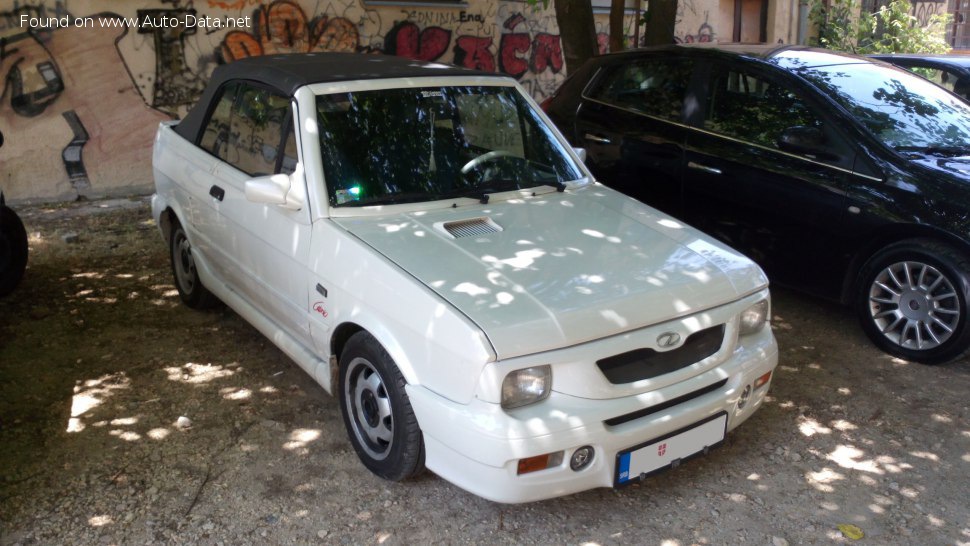
The Zastava Yugo Cabrio 1.3 i, produced from 2002 to 2008, represents a relatively late and somewhat unexpected iteration of the Yugo line. Originally conceived in the early 1980s as a low-cost, accessible vehicle for the Yugoslavian market, the Yugo gained notoriety – and a somewhat dubious reputation – when imported to the United States in the late 1980s and early 1990s. While the initial US-market Yugo was a basic sedan, the Cabrio model offered a more appealing, open-air experience. This article details the technical specifications and characteristics of the later 1.3 i Cabrio variant, focusing on its engineering and place within the broader Yugo story.
Zastava Yugo Cabrio 1.3 i: A Detailed Overview
The Yugo, manufactured by Zavodi Crvene Zvezde (Red Star Factories) in Kragujevac, Serbia (then part of Yugoslavia), was based on the Fiat 127. The Cabrio version, introduced later in the production run, aimed to inject some style and desirability into the aging platform. While not widely exported beyond Europe, the Cabrio offered a budget-friendly convertible option in markets where small, economical cars were popular. The 1.3 i designation refers to the engine displacement and fuel injection system, representing a modest upgrade over earlier carburetor-equipped models.
Engine & Performance
The Zastava Yugo Cabrio 1.3 i is powered by an inline four-cylinder engine displacing 1299 cubic centimeters (79.27 cubic inches). This engine produces 68 horsepower at 5500 rpm and 100 Newton-meters (73.76 lb.-ft.) of torque at 3800 rpm. While these figures are modest by modern standards, they were considered adequate for a vehicle of this size and weight. The engine features multi-port fuel injection and a compression ratio of 9.1:1. Power per liter is rated at 52.3 hp/l. The engine is transversely mounted at the front of the vehicle.
Performance is predictably unhurried. Acceleration from 0 to 100 km/h (0 to 62 mph) takes approximately 14 seconds, while 0 to 60 mph is achieved in around 13.3 seconds. The top speed is 155 km/h (96.31 mph). The weight-to-power ratio is 12.6 kg/Hp, and the weight-to-torque ratio is 8.6 kg/Nm. Power is delivered to the front wheels via a five-speed manual transmission. The drivetrain architecture is a conventional front-wheel-drive setup with an internal combustion engine (ICE).
Design & Features
The Yugo Cabrio is a two-door, four-seat convertible. Its design reflects the styling trends of the 1980s, with a boxy silhouette and relatively simple lines. The convertible top is manually operated, offering an open-air driving experience. The body length is 3540 mm (139.37 in), width is 1548 mm (60.94 in), and height is 1390 mm (54.72 in). The wheelbase measures 2150 mm (84.65 in).
Safety features were limited, typical for vehicles in its price range and era. The Yugo Cabrio 1.3 i did include an Anti-lock Braking System (ABS), which was a notable addition for a car of this class. Braking consists of disc brakes at the front and drum brakes at the rear. Steering is rack and pinion. The vehicle rides on 155/70 R13 tires. Interior features were basic, prioritizing functionality over luxury. Trunk space is limited to 170 liters (6 cubic feet). The kerb weight is 855 kg (1884.95 lbs), with a maximum weight of 1220 kg (2689.64 lbs) and a maximum load capacity of 365 kg (804.69 lbs).
Technical Specifications
| Brand | Zastava |
| Model | Yugo |
| Generation | Yugo Cabrio |
| Type (Engine) | 1.3 i (68 Hp) |
| Start of production | 2002 |
| End of production | 2008 |
| Powertrain Architecture | Internal Combustion engine |
| Body type | Cabriolet |
| Seats | 4 |
| Doors | 2 |
| Fuel Type | Petrol (Gasoline) |
| Acceleration 0 – 100 km/h | 14 sec |
| Acceleration 0 – 62 mph | 14 sec |
| Acceleration 0 – 60 mph | 13.3 sec |
| Maximum speed | 155 km/h (96.31 mph) |
| Weight-to-power ratio | 12.6 kg/Hp |
| Weight-to-torque ratio | 8.6 kg/Nm |
| Power | 68 Hp @ 5500 rpm |
| Power per litre | 52.3 Hp/l |
| Torque | 100 Nm @ 3800 rpm (73.76 lb.-ft. @ 3800 rpm) |
| Engine layout | Front, Transverse |
| Engine displacement | 1299 cm3 (79.27 cu. in.) |
| Number of cylinders | 4 |
| Engine configuration | Inline |
| Cylinder Bore | 86.4 mm (3.4 in.) |
| Piston Stroke | 55.38 mm (2.18 in.) |
| Compression ratio | 9.1:1 |
| Number of valves per cylinder | 2 |
| Fuel injection system | Multi-port manifold injection |
| Engine aspiration | Naturally aspirated engine |
| Kerb Weight | 855 kg (1884.95 lbs.) |
| Max. weight | 1220 kg (2689.64 lbs.) |
| Max load | 365 kg (804.69 lbs.) |
| Trunk (boot) space – minimum | 170 l (6 cu. ft.) |
| Fuel tank capacity | 48 l (12.68 US gal | 10.56 UK gal) |
| Length | 3540 mm (139.37 in.) |
| Width | 1548 mm (60.94 in.) |
| Height | 1390 mm (54.72 in.) |
| Wheelbase | 2150 mm (84.65 in.) |
| Front track | 1310 mm (51.57 in.) |
| Rear (Back) track | 1310 mm (51.57 in.) |
| Drivetrain Architecture | Front wheel drive |
| Drive wheel | Front wheel drive |
| Number of gears and type of gearbox | 5 gears, manual transmission |
| Front suspension | Coil spring |
| Rear suspension | Coil spring |
| Front brakes | Disc |
| Rear brakes | Drum |
| Assisting systems | ABS (Anti-lock braking system) |
| Steering type | Steering rack and pinion |
| Tires size | 155/70 R13 |
The Zastava Yugo Cabrio 1.3 i, while not a performance car, offered an affordable and relatively cheerful way to experience open-air motoring. Its legacy is complex, marked by both its accessibility and its reputation for unreliability. However, it remains a curious and somewhat endearing footnote in automotive history, particularly for those familiar with its brief but memorable foray into the American market.