
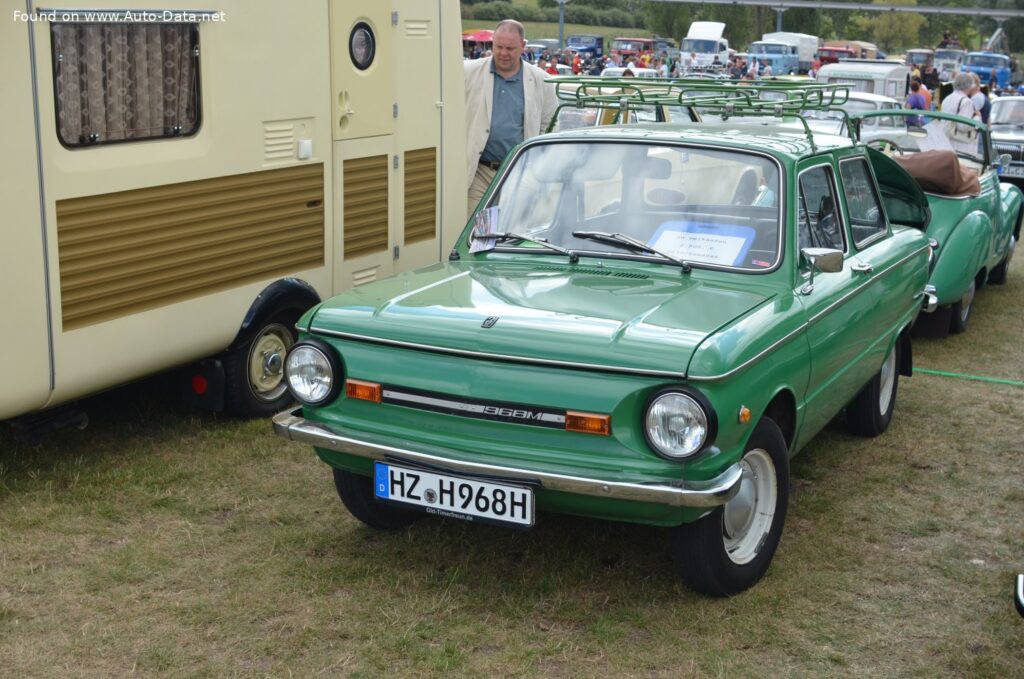
The ZAZ 968M, particularly the 1.2-liter V4 variant producing 42 horsepower, represents a significant chapter in the history of Ukrainian automotive manufacturing. Produced from 1979 to 1994, the 968M was a modernized iteration of the earlier ZAZ 968, itself a descendant of the iconic ZAZ 966 “Zaporozhets.” This specific 42 hp version occupied the entry-level position within the 968M lineup, offering affordable transportation to a broad segment of the Soviet and later Ukrainian population. It was designed as a compact, economical coupe, intended for everyday use and characterized by its distinctive rear-engine, rear-wheel-drive layout.
ZAZ 968M 1.2 V4 (42 Hp): An Overview
The ZAZ 968M was built upon the foundations of the original 968, incorporating numerous improvements in terms of styling, comfort, and reliability. The “M” designation signified “Modernizirovanniy” (Modernized). While retaining the core mechanical layout of its predecessors, the 968M featured a more refined interior, improved body panels, and a slightly larger engine displacement. The 1.2-liter engine, while modest in output by Western standards, was considered adequate for the vehicle’s weight and intended purpose. The 968M was primarily sold within the Soviet Union and Eastern European markets, with limited exports elsewhere.
Powertrain & Engine Architecture
The heart of the ZAZ 968M 1.2 V4 (42 hp) is its 1197 cc (73.05 cu. in.) V4 engine, designated as the MeMZ-968M. This engine is a naturally aspirated, four-cylinder unit with a 76 mm bore and 66 mm stroke, resulting in a compression ratio of 7.2:1. It features a carburetor fuel injection system – typically a K-126G or similar – which was a common technology for the time, but less efficient and precise than modern fuel injection systems. The engine utilizes a single overhead camshaft (SOHC) valvetrain with two valves per cylinder. The engine is mounted longitudinally in the rear of the vehicle, driving the rear wheels. This rear-engine layout, while providing certain packaging advantages, contributed to the car’s unique handling characteristics.
The standard transmission for the 42 hp variant was a four-speed manual gearbox. An automatic transmission was not offered on this base model. The gearbox was designed to be robust and simple, prioritizing durability over performance. The clutch was a single-plate dry clutch. The engine’s relatively low power output and the gearbox’s gearing were geared towards maximizing fuel economy and providing acceptable acceleration in urban environments.
Driving Characteristics
The driving experience in a ZAZ 968M 1.2 V4 (42 hp) is distinctly different from that of a modern automobile. The rear-engine layout imparts a noticeable rearward weight bias, which can lead to oversteer, particularly when cornering aggressively. The steering, utilizing a cone worm and recirculating ball mechanism, is relatively heavy and lacks the precision of modern rack-and-pinion systems. Acceleration is modest, with a 0-60 mph time of approximately 30.4 seconds and a top speed of around 74.56 mph (120 km/h). The engine delivers its peak power of 42 hp at 4200 rpm and 74 Nm (54.58 lb-ft) of torque at 2700 rpm. The power delivery is relatively linear, but the engine feels strained at higher speeds. Compared to later, slightly more powerful versions of the 968M, the 42 hp model felt noticeably slower, especially when carrying passengers or cargo. The manual transmission requires deliberate shifting, and the lack of synchronization on first gear was a common characteristic.
Equipment & Trim Levels
The ZAZ 968M 1.2 V4 (42 hp) was typically equipped with basic, functional features. Standard equipment included cloth upholstery, simple steel wheels with hubcaps, and basic instrumentation consisting of a speedometer, fuel gauge, and temperature gauge. The interior was spartan but reasonably durable. Heating and ventilation were standard, but air conditioning was not available. Optional extras were limited, but could include upgraded seat covers, a radio, and occasionally, a more sophisticated instrument cluster. The exterior trim was minimal, with chrome accents around the windows and bumpers. The body was typically finished in a range of solid colors, with limited metallic paint options.
Chassis & Braking
The ZAZ 968M featured a relatively simple chassis design. The suspension consisted of independent front suspension with trailing arms and coil springs, and a semi-trailing arm rear suspension with coil springs. The rear suspension geometry was influenced by the rear-engine layout. The braking system was equally straightforward, utilizing drum brakes on all four wheels. The drum brakes, while adequate for the vehicle’s weight and performance, lacked the stopping power and fade resistance of disc brakes. The 155/70 R13 tires provided reasonable grip, but were not designed for high-speed cornering. A stabilizer bar was not typically fitted to the base 42 hp model.
Market Reception & Comparison
The ZAZ 968M 1.2 V4 (42 hp) was primarily viewed as an affordable and practical means of transportation within its target market. Critics generally acknowledged its simplicity, durability, and fuel efficiency. However, it was also criticized for its modest performance, basic interior, and somewhat quirky handling characteristics. Compared to other trims within the 968M lineup, such as those equipped with the slightly more powerful 1.3-liter engine, the 42 hp version was considered less refined and less capable. However, its lower price point made it accessible to a wider range of buyers. Fuel economy was a strong point, achieving around 9.5 l/100 km (24.8 US mpg) in urban conditions and 6.5 l/100 km (36.2 US mpg) on the open road. Reliability was generally good, although the carburetor required periodic adjustment and maintenance.
Technical Specifications
| Brand | ZAZ |
| Model | 968M |
| Generation | 968M |
| Type (Engine) | 1.2 V4 (42 Hp) |
| Start of production | 1979 year |
| End of production | 1994 year |
| Fuel consumption (urban) | 9.5 l/100 km (24.8 US mpg) |
| Fuel consumption (extra urban) | 6.5 l/100 km (36.2 US mpg) |
| Fuel Type | Petrol (Gasoline) |
| Acceleration 0 – 100 km/h | 32 sec |
| Acceleration 0 – 62 mph | 32 sec |
| Acceleration 0 – 60 mph | 30.4 sec |
| Maximum speed | 120 km/h (74.56 mph) |
| Weight-to-power ratio | 19 kg/Hp |
| Power | 42 Hp @ 4200 rpm |
| Torque | 74 Nm @ 2700 rpm (54.58 lb.-ft. @ 2700 rpm) |
| Engine layout | Rear, Longitudinal |
| Engine displacement | 1197 cm3 (73.05 cu. in.) |
| Number of cylinders | 4 |
| Engine configuration | V-engine |
| Cylinder Bore | 76 mm (2.99 in.) |
| Piston Stroke | 66 mm (2.6 in.) |
| Compression ratio | 7.2:1 |
| Number of valves per cylinder | 2 |
| Fuel injection system | Carburettor |
| Kerb Weight | 800 kg (1763.7 lbs.) |
| Max. weight | 1200 kg (2645.55 lbs.) |
| Fuel tank capacity | 40 l (10.57 US gal | 8.8 UK gal) |
| Length | 3765 mm (148.23 in.) |
| Width | 1490 mm (58.66 in.) |
| Height | 1425 mm (56.1 in.) |
| Wheelbase | 2160 mm (85.04 in.) |
| Drive wheel | Rear wheel drive |
| Number of gears | 4 gears, manual transmission |
Legacy
The ZAZ 968M 1.2 V4 (42 hp) remains a fondly remembered vehicle in many parts of the former Soviet Union and Eastern Europe. While not known for its performance or luxury, it provided affordable and reliable transportation for millions of people. Today, it has become a collectible item, particularly among enthusiasts of classic cars and Soviet-era vehicles. The 1.2-liter engine, while relatively simple, proved to be reasonably durable, and many examples are still in running condition. However, finding spare parts can be challenging, and maintenance often requires specialized knowledge. The 968M’s unique design and historical significance continue to ensure its place in automotive history.
