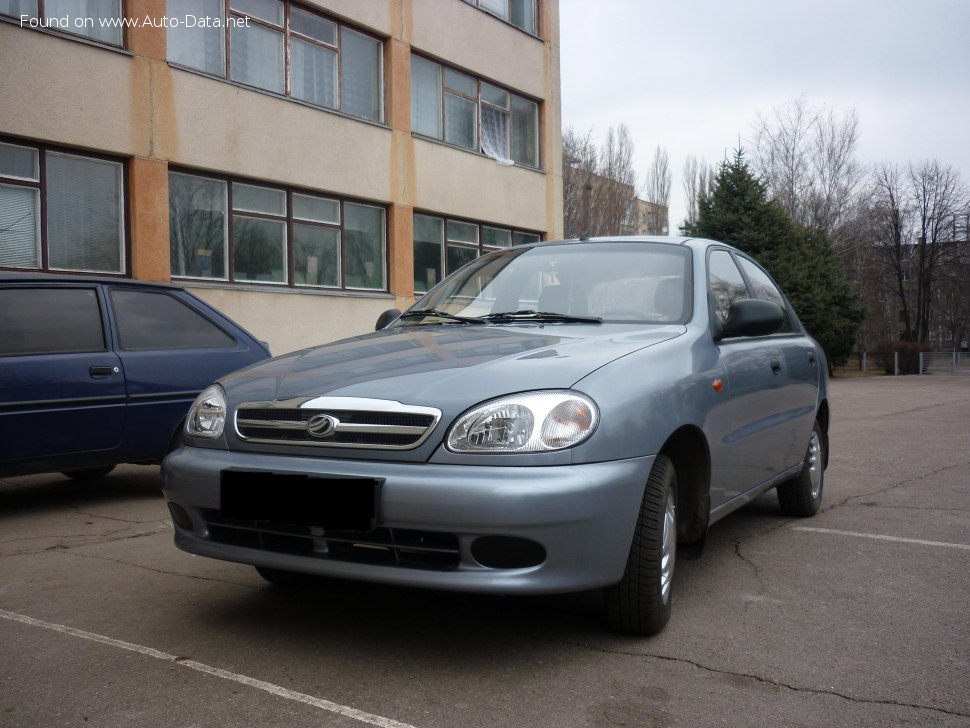
The ZAZ Sens Sedan 1.3 i (70 hp) was a subcompact car produced by the Ukrainian automobile manufacturer ZAZ (Zaporozhzhya Automobile Building Plant) from 2002 to 2018. It represented a significant step for ZAZ, being one of the first domestically produced vehicles following Ukraine’s independence. The Sens Sedan was based heavily on the Daewoo Lanos platform, acquired after Daewoo’s withdrawal from the Ukrainian market, and aimed to provide affordable transportation to a growing middle class. The 1.3 i variant, producing 70 horsepower, served as the entry-level model within the Sens lineup, positioned below the 1.5 and 1.6 liter options. It was designed to appeal to budget-conscious buyers prioritizing fuel efficiency and basic reliability over outright performance.
ZAZ Sens Sedan 1.3 i: Powertrain & Engine Architecture
The heart of the ZAZ Sens 1.3 i was the Chery 474 engine, a 1.3-liter inline-four cylinder gasoline engine. This engine, while originally designed by Chery Automobile of China, was adapted for use in the ZAZ Sens. It featured a single overhead camshaft (SOHC) valvetrain with two valves per cylinder. The engine utilized a multi-port fuel injection (MPFI) system, providing a balance between fuel efficiency and acceptable performance for its intended market segment. The engine’s displacement was 1299 cm³ (79.27 cubic inches), and it produced a maximum power output of 70 hp at 5500 rpm and 108 Nm (79.66 lb-ft) of torque at 3250 rpm. The compression ratio was 9.8:1. The engine was transversely mounted in the front of the vehicle.
The 1.3 i Sens Sedan was exclusively offered with a five-speed manual transmission. This transmission was chosen to maximize fuel economy and keep production costs down. The gearbox was a standard, non-synchronized design, prioritizing simplicity and durability over sophisticated shift quality. The transmission’s gear ratios were geared towards economy, with a relatively tall final drive ratio.
Engine Codes and Variations
While the core engine architecture remained consistent throughout the production run, minor variations existed. Early models (2002-2008) utilized a slightly different engine management system compared to later iterations. These changes were primarily focused on improving emissions compliance and refining engine operation. However, the fundamental characteristics of the 1.3-liter engine remained largely unchanged.
Driving Characteristics
The ZAZ Sens 1.3 i offered modest performance. Acceleration from 0 to 100 km/h (0 to 62 mph) took approximately 18.4 seconds, and 0 to 60 mph was achieved in around 17.5 seconds. The top speed was limited to 148 km/h (91.96 mph). The engine’s power delivery was relatively linear, but it lacked significant low-end torque. This meant that drivers often needed to downshift to maintain momentum when climbing hills or overtaking other vehicles. Compared to the 1.5 and 1.6 liter versions of the Sens, the 1.3 i felt noticeably slower and less refined. However, the 1.3 i’s lighter weight and simpler mechanicals contributed to better fuel economy.
The five-speed manual transmission was relatively easy to operate, but the shift linkage could feel imprecise. The clutch pedal was light, making it suitable for city driving. Overall, the driving experience was best described as utilitarian, prioritizing functionality over excitement.
Equipment & Trim Levels
The ZAZ Sens 1.3 i was typically offered in a single, base trim level. Standard equipment included basic steel wheels with hubcaps, black plastic bumpers, and cloth upholstery. The interior was spartan, with minimal creature comforts. Air conditioning, power windows, and central locking were typically optional extras, often bundled together in packages. The dashboard was constructed from hard plastics, and the instrument cluster featured a basic analog speedometer, tachometer, and fuel gauge. Safety features were also limited, with only a driver’s airbag and seatbelts as standard equipment. Later models saw the introduction of slightly upgraded interior materials and the availability of a basic audio system as an option.
Chassis & Braking
The ZAZ Sens 1.3 i utilized a relatively simple chassis design. The front suspension consisted of MacPherson struts with a transverse stabilizer bar, while the rear suspension employed a semi-independent torsion beam setup. This suspension configuration provided a reasonable ride quality, but it was not particularly sophisticated. The braking system featured ventilated discs on the front wheels and drum brakes on the rear wheels. The steering was a rack and pinion system, providing adequate steering feel and precision. Tire size was typically 155/80 R13. The relatively light weight of the 1.3 i model (1081 kg / 2383.2 lbs) helped to compensate for the limitations of the braking system.
Market Reception & Comparison
The ZAZ Sens 1.3 i was generally well-received in Ukraine and other Eastern European markets as an affordable and reliable means of transportation. Critics praised its low purchase price and relatively good fuel economy (7.2 l/100 km combined, 32.7 US mpg). However, it was also criticized for its basic interior, lack of safety features, and modest performance. Compared to the higher-trim Sens models (1.5 and 1.6 liter), the 1.3 i offered significantly less power and refinement. However, it was also more fuel-efficient and less expensive to purchase and maintain. In terms of reliability, the 1.3 i engine proved to be reasonably durable, although regular maintenance was essential. It competed primarily with other budget-oriented subcompact cars, such as the Lada Priora and various used imports.
Technical Specifications
| Brand | ZAZ |
| Model | Sens Sedan |
| Engine Type | Inline-4, Petrol |
| Engine Displacement | 1299 cm³ (79.27 cu. in.) |
| Power | 70 hp @ 5500 rpm |
| Torque | 108 Nm @ 3250 rpm (79.66 lb.-ft.) |
| Fuel Consumption (Urban) | 8.9 l/100 km (26.4 US mpg) |
| Fuel Consumption (Extra Urban) | 5.5 l/100 km (42.8 US mpg) |
| Fuel Consumption (Combined) | 7.2 l/100 km (32.7 US mpg) |
| Transmission | 5-speed Manual |
| Drive Type | Front Wheel Drive |
| Kerb Weight | 1081 kg (2383.2 lbs) |
| Maximum Weight | 1400 kg (3086.47 lbs) |
| Trunk Space (Minimum) | 322 l (11.37 cu. ft.) |
| Trunk Space (Maximum) | 958 l (33.83 cu. ft.) |
| Length | 4237 mm (166.81 in.) |
| Width | 1678 mm (66.06 in.) |
| Height | 1432 mm (56.38 in.) |
Legacy
The ZAZ Sens 1.3 i played a crucial role in revitalizing the Ukrainian automotive industry. It provided a domestically produced alternative to imported vehicles, making car ownership more accessible to a wider range of consumers. While the Sens has since been replaced by newer models, the 1.3 i variant remains a common sight on Ukrainian roads. The engine itself, while not particularly advanced, proved to be relatively reliable and easy to maintain. In the used car market, the Sens 1.3 i is valued for its affordability and low running costs. However, potential buyers should be aware of its limited performance and basic features. Parts availability is generally good, as the Sens was produced in large numbers and shared many components with other vehicles. Overall, the ZAZ Sens 1.3 i represents a significant chapter in Ukrainian automotive history, offering a practical and economical transportation solution for a generation of drivers.