
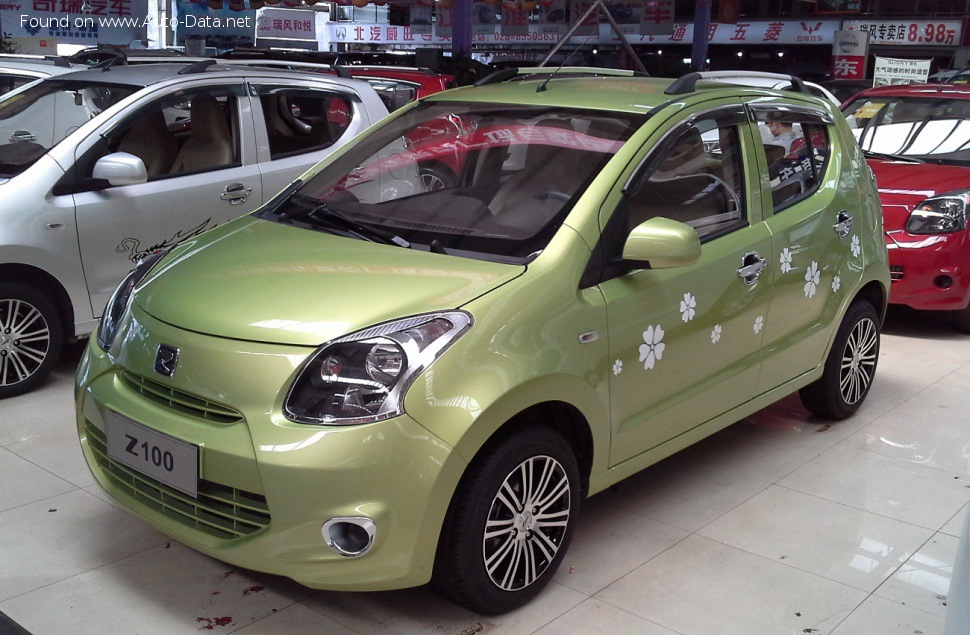
The Zotye Z100 17.8 kWh (25 hp) EV is a fully electric hatchback produced by the Chinese automaker Zotye Auto from 2015 to 2017. It represented Zotye’s early foray into the burgeoning electric vehicle market, aimed at providing an affordable and practical city car. The Z100 was positioned as an entry-level electric vehicle, intended for urban commuters and those seeking a low-cost alternative to gasoline-powered vehicles. It was a relatively short-lived model, superseded by later Zotye EVs with improved range and performance.
Zotye Z100 17.8 kWh EV: Powertrain & Engine Architecture
The Zotye Z100 is powered by a single electric motor producing 25 horsepower (18.6 kW) and 120 Nm (88.51 lb-ft) of torque. The vehicle utilizes a 17.8 kWh lithium-ion battery pack, providing an all-electric range of approximately 150 kilometers (93.21 miles) under optimal driving conditions. The powertrain is a Battery Electric Vehicle (BEV) configuration, meaning it relies solely on electricity for propulsion. The single-speed automatic transmission simplifies operation, delivering power to the front wheels. The electric motor itself is a permanent magnet synchronous motor, chosen for its efficiency and relatively compact size. The battery management system (BMS) is a crucial component, responsible for monitoring and controlling the battery’s charging and discharging processes, ensuring longevity and safety. The Z100’s charging port is designed for standard AC charging, with a full charge taking several hours depending on the charging infrastructure available.
Electric Motor and Battery Details
The 25 hp electric motor, while modest in output, provides sufficient power for navigating urban environments. The 120 Nm of torque is available instantly, offering brisk acceleration from a standstill. The 17.8 kWh battery pack is relatively small by modern EV standards, contributing to the Z100’s affordability but limiting its range. The battery chemistry is not widely publicized, but it is likely a Lithium Iron Phosphate (LiFePO4) or Nickel Manganese Cobalt (NMC) formulation, common in EVs of this era. Energy consumption is rated at 10 kWh per 100 kilometers (16.09 kWh per 100 miles), equating to approximately 209 MPGe (miles per gallon equivalent) and 10 km/kWh (6.2 mi/kWh).
Driving Characteristics
The Zotye Z100’s driving experience is characterized by its smooth and quiet operation, typical of electric vehicles. Acceleration is adequate for city driving, with the instant torque providing responsive performance at lower speeds. However, its limited horsepower becomes apparent at higher speeds or when carrying a full load. The single-speed automatic transmission simplifies driving, eliminating the need for gear changes. Top speed is limited to 85 km/h (52.82 mph). The Z100’s relatively lightweight construction (968 kg / 2134.07 lbs) helps to offset the low power output, contributing to a reasonably agile feel in urban traffic. Compared to gasoline-powered vehicles in its price range, the Z100 offers a more refined and relaxing driving experience, thanks to the absence of engine noise and vibrations. However, it lacks the long-range capability and higher performance of more expensive EVs.
Equipment & Trim Levels
The Zotye Z100 was offered with a relatively basic level of equipment, reflecting its position as an entry-level vehicle. Standard features typically included power steering, ABS (Anti-lock Braking System), and a basic audio system. Interior upholstery was typically cloth, and the dashboard design was functional rather than luxurious. Air conditioning was often an optional extra. The Z100’s interior space is adequate for five passengers, although rear legroom is somewhat limited. The hatchback body style provides a practical cargo area, suitable for everyday shopping and errands. Trim levels were limited, with most Z100s being equipped with a similar set of features. Optional extras, when available, might have included power windows, central locking, and upgraded audio systems.
Chassis & Braking
The Zotye Z100 utilizes an independent McPherson strut suspension system at the front and an independent coil spring suspension at the rear. This suspension setup provides a comfortable ride quality, absorbing bumps and irregularities in the road surface. The steering system is a rack and pinion type with electric power steering, offering precise and responsive handling. The braking system consists of disc brakes at the front and drum brakes at the rear. The ABS (Anti-lock Braking System) enhances safety by preventing wheel lockup during emergency braking. Tire size is 165/60 R14, mounted on 14-inch steel wheels. The Z100’s chassis is designed to be lightweight and rigid, contributing to its handling stability and overall safety.
Market Reception & Comparison
The Zotye Z100 received mixed reviews from automotive critics. While praised for its affordability and practicality, it was criticized for its limited range, low power output, and basic interior. Compared to other EVs available at the time, the Z100 offered a compelling value proposition for budget-conscious buyers. However, it lacked the sophistication and performance of more established EV models. In terms of fuel economy, the Z100’s electricity consumption of 10 kWh/100 km was competitive with other EVs of its size and class. Reliability reports are limited, but the Z100’s relatively simple powertrain suggests that it should be reasonably reliable with proper maintenance. The Z100 primarily competed with other small, low-cost EVs in the Chinese market.
Technical Specifications
| Brand | Zotye |
| Model | Z100 |
| Generation | Z100 |
| Type (Engine) | 17.8 kWh (25 Hp) EV |
| Start of production | 2015 |
| End of production | 2017 |
| Powertrain Architecture | BEV (Electric Vehicle) |
| Body type | Hatchback |
| Seats | 5 |
| Doors | 5 |
| Fuel Type | Electricity |
| Maximum speed | 85 km/h (52.82 mph) |
| Weight-to-power ratio | 38.7 kg/Hp, 25.8 Hp/tonne |
| Gross battery capacity | 17.8 kWh |
| All-electric range | 150 km (93.21 mi) |
| Average Energy consumption | 10 kWh/100 km (16.09 kWh/100 mi) |
| Electric motor power | 25 Hp |
| Electric motor Torque | 120 Nm (88.51 lb.-ft.) |
| System power | 25 Hp |
| Kerb Weight | 968 kg (2134.07 lbs.) |
| Max. weight | 1268 kg (2795.46 lbs.) |
| Max load | 300 kg (661.39 lbs.) |
| Length | 3559 mm (140.12 in.) |
| Width | 1620 mm (63.78 in.) |
| Height | 1476 mm (58.11 in.) |
| Wheelbase | 2360 mm (92.91 in.) |
| Front track | 1405 mm (55.31 in.) |
| Rear (Back) track | 1400 mm (55.12 in.) |
| Drive wheel | Front wheel drive |
| Number of gears and type of gearbox | 1 gears, automatic transmission |
| Front suspension | Independent type McPherson |
| Rear suspension | Independent coil spring |
| Assisting systems | ABS (Anti-lock braking system) |
| Steering type | Steering rack and pinion |
| Power steering | Electric Steering |
| Tires size | 165/60 R14 |
| Wheel rims size | 14 |
Legacy
The Zotye Z100, while not a groundbreaking vehicle, played a role in popularizing electric vehicles in China. It demonstrated that affordable EVs were possible, paving the way for more advanced and capable models. Today, the Z100 is a relatively rare sight on the roads, but it remains a collectible item for EV enthusiasts. Its simple powertrain and readily available parts suggest that it can be a reliable and inexpensive mode of transportation for those willing to maintain it. The Z100’s legacy lies in its contribution to the early development of the Chinese EV market and its demonstration of the potential for electric mobility.
